
A North Morocco journey from the Strait to the medina
The journey from Tangier to Fes by train is one of the most beautiful ways to cross northern Morocco: about three and a half hours from the edge of Europe to the oldest living medina in the Arab world.
It begins where two seas meet. From the ramparts of the Tangier Kasbah, the Strait of Gibraltar is close enough to read the hills of Spain on a clear morning. The light is white and salt-washed, the walls are washed in lime, and the city wakes slowly to mint tea and the call to prayer drifting down towards the port.
By afternoon you are somewhere else entirely. The train has carried you south along the Atlantic, then inland across wheat fields and olive groves, into the walled city of Fes, where twelve centuries of scholarship, craft and faith still shape daily life. This is our North Morocco itinerary: a journey through history and style, told in two cities and the rails between them.
Tangier: the Kasbah, the painters and the writers
Tangier is Morocco’s most cosmopolitan city, shaped by Phoenicians, Romans, Portuguese, British and, between 1923 and 1956, an International Zone governed by several foreign powers at once.
That layered past is still visible in the streets. The great traveller Ibn Battuta was born here in 1304 and set out from this coast on a journey of nearly thirty years. Centuries later, Delacroix arrived with sketchbooks and Matisse came for the light, painting the view from his window over the medina. Paul Bowles made Tangier his home for more than half a century, and the Beat writers followed him to its cafés.
We walk the Kasbah in the soft hours, when the alleys are quiet and the doorways glow blue and ochre. We take tea on terraces cut into the cliff, watching ferries cross towards Tarifa. We visit the American Legation, the first property the United States ever owned abroad, now a small museum of maps, letters and paintings. And we spend time with the artisans and designers who give the city its quiet, effortless style: weavers, leatherworkers and the new generation of concept stores tucked inside old merchant houses.
Tangier is where the group settles in. The pace is unhurried, the conversations are long, and the sea is never out of sight.
The train from Tangier to Fes: Al Boraq and the classic line
The fastest way to travel from Tangier to Fes is to take the Al Boraq high-speed train to Kenitra and change onto a classic train to Fes, a journey of around 3 hours 25 minutes. A direct train on the classic line takes a little over 4 hours.
Al Boraq was the first high-speed railway in Africa, running at up to 300 km/h on a line inspired by the French TGV. Leaving Tangier, it races along the Atlantic coast, the sea flashing between dunes and eucalyptus. At Kenitra the rhythm changes. The classic Al Atlas train turns inland, slower and more contemplative, through farmland, cork oak and the gentle hills of the Saïs plain, passing Meknes before rolling into Fes.
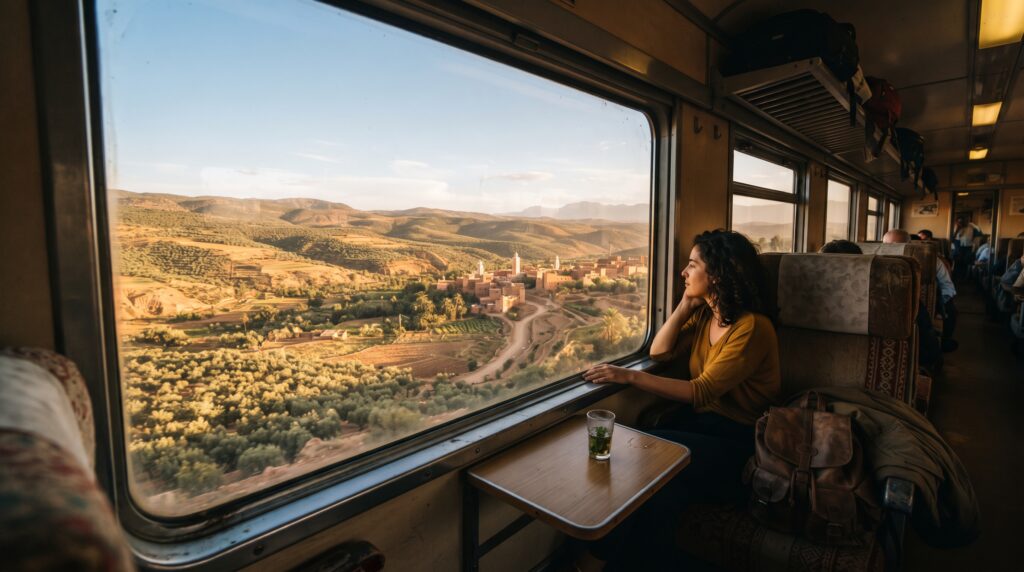
For groups, the train is far more than a transfer. Every seat is reserved, first-class carriages are calm and spacious, and there is time to read, journal, sketch or simply watch Morocco unfold through the window. We handle tickets, luggage and station transfers, so the only thing to carry is a notebook.
For groups who want more history on the way, we can pause at Meknes, the imperial city of Moulay Ismail, with an optional visit to the Roman ruins of Volubilis, a UNESCO World Heritage site.
Fes: a living medina of scholarship and craft
Fes is Morocco’s spiritual and intellectual capital, founded in the late 8th century, and its old medina, Fes el-Bali, is a UNESCO World Heritage site and one of the largest car-free urban areas in the world.
Here, history is not behind glass. It is in the donkey carts negotiating lanes no wider than outstretched arms, in the hammer of coppersmiths, in the scent of cedar shavings and fresh mint. At its heart stands al-Qarawiyyin, founded in 859 by Fatima al-Fihri and regarded as the oldest continuously operating university in the world. Nearby, the 14th-century medersas of the Marinid dynasty hold some of the finest carved stucco, cedarwood and zellij tilework in North Africa.
With a local guide who knows every turn, we move through the medina at a human pace. We watch the dyers at work from the terraces above the Chouara tannery, step into the workshops of potters shaping the famous Fes blue ceramics, and sit with artisans whose families have practised the same craft for generations. There are long lunches in courtyard houses, a cooking class built around the market, and evenings on rooftops as the call to prayer rises from hundreds of minarets at once.
Fes asks you to slow down. It rewards you with depth.
A North Morocco itinerary for yoga teachers and groups
Our Tangier to Fes itinerary is designed for yoga teachers, wellbeing leaders and private groups who want a Morocco retreat with real cultural depth, and with every logistical detail taken care of.
We have been designing group journeys since 2013, and North Morocco is one we return to with joy. The rhythm of the trip lends itself to retreat life: mornings for practice in courtyards and on rooftops, days for discovery, evenings for long tables and quiet conversation. The train journey becomes a shared moment of transition, a natural midpoint between two very different cities.
What we take care of:
- Characterful boutique stays in historic riads and design-led houses, chosen for groups
- Spaces suited to daily yoga, meditation or workshops
- Train tickets in first class, luggage handling and all station transfers
- Trusted local guides in Tangier and Fes, with small group sizes
- Curated encounters with artisans, designers and home cooks
- Gastronomy at the centre: market visits, cooking classes and memorable meals
- On-the-ground support from a licensed travel agency, from first enquiry to final farewell
You bring your group and your teaching. We shape everything around it, adapting the itinerary to your dates, your numbers and the experience you want your students to carry home.
Frequently asked questions
How long is the train from Tangier to Fes?
Around 3 hours 25 minutes with the Al Boraq high-speed train to Kenitra and a connection to Fes, or just over 4 hours on a direct train along the classic line.
Is the train a good way to travel around Morocco with a group?
Yes. Moroccan trains are comfortable, every ticket includes a reserved seat, and first class gives groups space to travel together. It is calmer and more scenic than a long coach transfer.
What is the best time of year to visit North Morocco?
Spring (March to May) and autumn (September to November) bring mild temperatures and soft light, ideal for walking the medinas and practising outdoors.
Can this itinerary be adapted for a yoga retreat or teacher-led group?
Yes. We tailor the Tangier to Fes itinerary to each group, including daily practice spaces, the number of nights in each city and optional stops such as Meknes and Volubilis.
Who organises this North Morocco trip?
Breathspiration, a boutique wellness travel and retreat company founded in Mallorca in 2013 and a licensed travel agency (AVBAL/849), designs and operates the journey from start to finish.
Bring your group to North Morocco
Some journeys are about arriving. This one is about the space in between: the light leaving Tangier, the landscape sliding past the window, the first glimpse of Fes from its hills.
If you are a yoga teacher, a retreat leader or someone gathering a group of curious travellers, we would love to design this journey with you. Tell us your dates and your vision, and we will shape North Morocco around your group.