
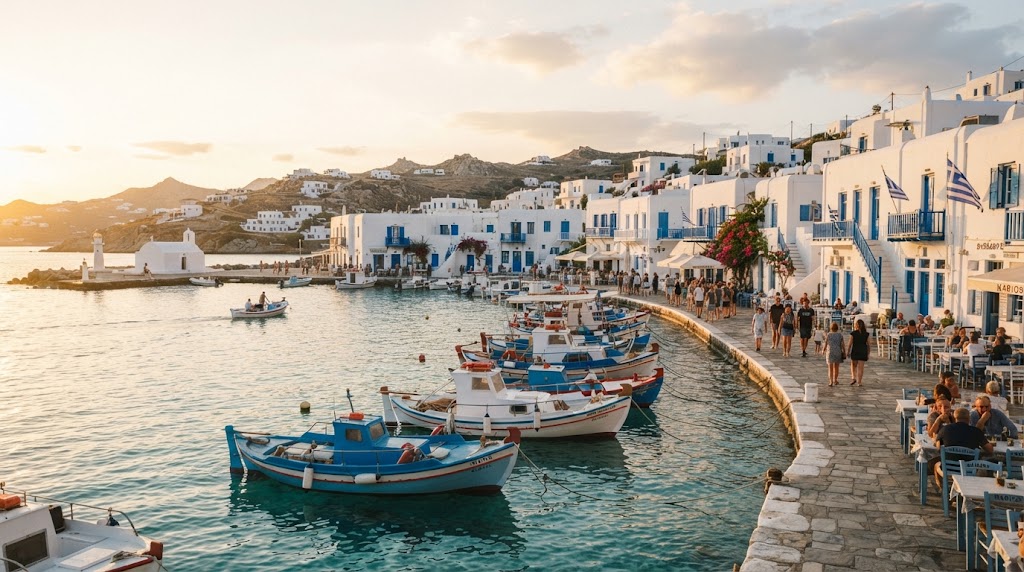
Ask anyone who has spent a week on Paros what they miss most, and the answers rarely involve a single sight. They talk about a three-hour lunch by the harbour, a swim off the side of a boat in water that looked lit from below, a marble lane in a village where nobody was in a hurry. Paros, in the heart of the Greek Cyclades, has a way of resetting your internal clock — and it does it with more sunshine, history and good food than any island this size has a right to.
Paros, Greece: The Cycladic Island That Still Belongs to Itself
Paros sits in the middle of the Aegean, a few hours by ferry from Athens or a short flight of under an hour, and yet it has held on to something its more famous neighbours have quietly traded away. Less crowded than Mykonos, more lived-in than Santorini, it is a working island: fishermen still mend their yellow nets on the harbour wall at dawn, village kafeneios open when the owner is ready, and cats nap on marble steps warmed by centuries of sun.
That marble is the island’s great secret. Parian marble was the most prized stone of the ancient world — luminous, almost translucent, carved into some of its most celebrated sculptures. On Paros it is simply part of everyday life, underfoot and in the walls. Cycladic islanders, classical Greeks, Byzantines, Venetians and Ottomans all passed through, and each left a layer of history waiting to be discovered.
Our Paros Itinerary: Four Places, One Island Rhythm
The best things to do in Paros come down to four places, each with its own personality: the historic port town, the hidden mountain village, the fishing harbour and the islands across the water. Mornings are for exploring, afternoons for slowing down, evenings for the long table.
Parikia: History, a Hundred Doors and the Best Sunset in Paros
Parikia is the island’s port and its oldest heart. Step away from the waterfront and you are instantly — and happily — lost in a maze of whitewashed lanes, blue shutters and pots of basil. At its centre stands the Panagia Ekatontapiliani, the Church of a Hundred Doors: legend links it to Saint Helena in the 4th century, it was rebuilt under Emperor Justinian, and today it is one of the best-preserved early Christian churches in Greece.
Up on the hill, the 13th-century Venetian kastro has a story of its own. Its walls were built from the columns and marble blocks of ancient temples, still visible in the masonry — architectural recycling, Venetian style. We end the day here with the most famous sunset in Paros, followed by grilled octopus, creamy fava with capers and a glass of chilled local wine.
Lefkes & the Byzantine Path: The Village in the Hills
High in the island’s interior, Lefkes was built out of sight of the sea so that pirates couldn’t find it, and for a time it served as the capital of Paros. It remains one of the most beautiful villages in the Cyclades: marble-paved lanes, flowering courtyards, the twin bell towers of Agia Triada and the scent of thyme and pine drifting through the air. Potters and weavers still work in small studios tucked into the alleys, keeping crafts alive that have been handed down for generations.
From the edge of the village we walk the Byzantine path, a stone trail around a thousand years old that winds through olive groves and terraced fields towards the sea. It is mostly downhill, which makes it the most relaxing hike you will ever brag about. Lunch in a village taverna is island food at its most honest — slow-cooked goat, chickpeas baked overnight in a clay pot, wild greens, local cheese and a small glass of souma, the island’s homemade spirit.
Naoussa: The Fishing Harbour That Steals Every Heart
Naoussa, on the north coast, is Paros at its most charming. Blue, red and yellow fishing boats bob in a tiny harbour guarded by the half-sunken ruins of a Venetian castle, and tavernas set their tables so close to the water you could almost dip your toes in. Across the bay lies Kolymbithres, one of the best beaches in Paros, where wind and waves have carved the granite into smooth, sculptural shapes and natural pools.
When the sun goes down, Naoussa wakes up. We browse small ateliers and island designers before settling into an ouzeri for meze — charcoal-grilled octopus, fresh sardines, tomato fritters and kalamaki, with ouzo turning cloudy over ice. Dinner here is never quick, and nobody wants it to be.
Antiparos by Boat: Hidden Beaches & Turquoise Water
This is the day everyone talks about on the flight home. A private boat trip from Paros to Antiparos, the island’s small and easygoing neighbour, opens up a coastline of secret coves reachable only from the sea. The sand is pale, the water shifts from turquoise to deep sapphire, and the only plan is to jump in, swim, snorkel and repeat.
History follows us even here. Just off Antiparos lies Despotiko, a tiny uninhabited island with an ancient sanctuary of Apollo, where archaeologists are still uncovering marble temples from the 6th century BC. Lunch is whatever the sea and the season offer — the morning’s catch, a horiatiki salad heavy with tomatoes and feta, bread to soak up the olive oil — followed by a long conversation in the shade and a slow sail home at golden hour.
The Greek Lifestyle: Siga Siga, Filoxenia & the Art of the Long Table
The real souvenir from Paros isn’t a photo; it’s a new rhythm. Within a few days you will understand siga siga — slowly, slowly — the philosophy that lets lunch last three hours and turns every coffee into a conversation. You will feel filoxenia, the famous Greek hospitality, in the taverna owner who sends out a plate you didn’t order and the neighbour who hands you tomatoes from her garden. You will taste meraki, the art of doing something with soul, in a grandmother’s spanakopita. And as the heat lifts each evening, you will find yourself joining the volta, the harbour stroll where whole families walk, greet friends and simply enjoy being together.
Sunshine & the Best Time to Visit Paros
Paros is an island of light. Long, cloudless days stretch from late spring into autumn, and the meltemi breeze keeps summer pleasantly fresh. The best time to visit Paros is late May, June and September, when the sea is warm, the light is golden and the villages feel lived-in rather than crowded. Early October brings softer days and quieter beaches — perfect for walking and slow travel. Five to seven days is the ideal length for a Paros itinerary, with time for every village, a boat day and plenty of unhurried lunches.
The Short Version
Paros offers what few Greek islands can: three thousand years of history in marble and stone, golden beaches and hidden coves, honest island food, generous sunshine and a way of life that is still genuinely lived. It is less crowded than its famous neighbours, easy to explore and made for sharing — which is exactly why it is one of our favourite destinations for group travel in Greece.
Bring Your Group or Travel With Friends to Paros
Paros is an island built for togetherness: long tables, shared boats, shared paths, shared sunsets. If you are a yoga teacher or wellbeing professional, imagine a Paros yoga retreat with your practice held above the Aegean and days of swimming, walking and island exploring woven around it. If you are planning a trip with friends or a milestone celebration, imagine a week where every detail is taken care of and the only decision left is which cove to swim in. If you lead a team, imagine the conversations that open up when you take them far from the office and into the Greek rhythm of life.
We design every journey around you: the right home base, the right pace and the local people who make the island come alive. Bring your group, gather your friends, and come travel with us to Paros.